
Dogs communicate with humans and each other using body language. Many behavior issues stem from humans misinterpreting what dogs are trying to say: either to them or other dogs. With practice, you can learn how to accurately observe and interpret what your dog is saying.
What you'll learn in this article:
- How to interpret your dog’s orientation, placement, weight, posture, and ear position
- How to recognize displacement behaviors
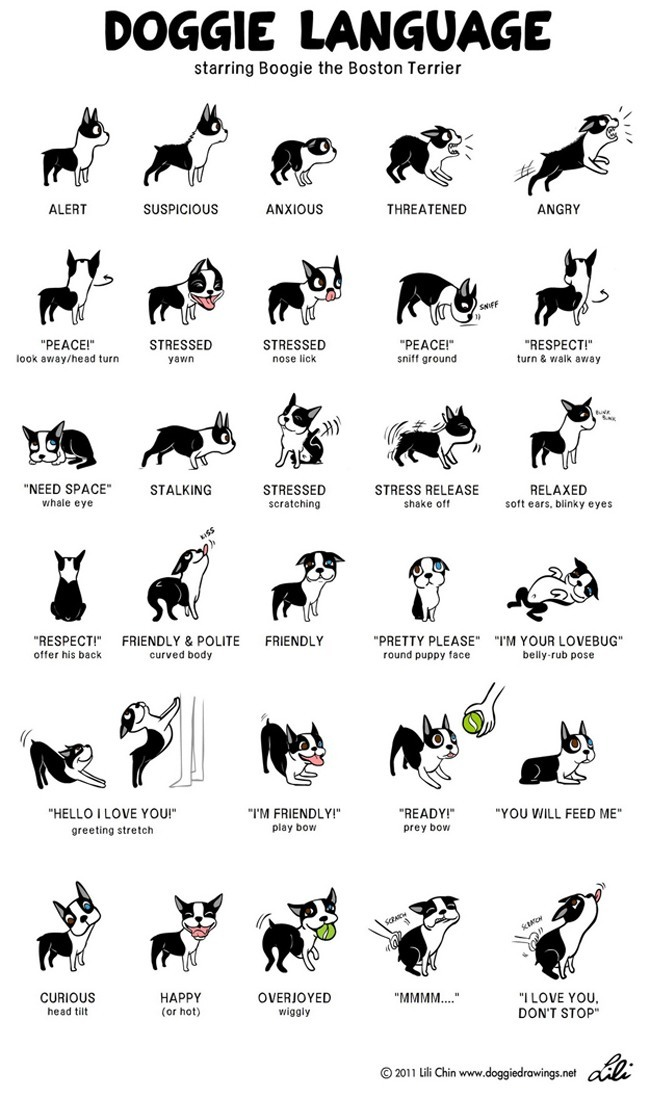
When you’re first starting to get to know your dog, the most important thing is to learn to read the signs that your dog is feeling uncomfortable. Pay attention to the warning signs, and never punish them when you notice them. If warning signs are ignored or scolded, your dog may stop giving warnings and instead escalate their behavior to biting or worse. Understanding your dog’s basic warning signals gives you the chance to remove your dog from situations where they feel stressed.
First, remember that behavior is always contextual. In addition to reading your dog’s signals, you need to take note of environmental cues in order to put your dog’s behavior into context and decide what to do next. This information will empower you to recognize and remove your dog from uncomfortable situations quickly. With that in mind, here are six core factors to pay attention to when evaluating your dog’s body language:
Orientation: Where your dog is looking and where their body is pointing
What your dog is looking at and where their body is pointing is a good indication of what your dog is focused on. Knowing this information is valuable because it puts you in a good position to predict what they will do next.
Placement: Where your dog is in relation to the "thing" that's captured their attention
Is your dog close to you? How far is the “thing” that’s captured their attention? Are there cats, strangers, garbage trucks, etc on the street? Taking note of these environmental factors will potentially give you information on what frightens and excites your dog.
Weight: Where your dog is leaning
How your dog carries their weight will tell you a lot about how they’re feeling:
- Centered weight generally indicates baseline/resting state
- Weight shifted forward generally indicates confidence towards the stimulus
- Weight shifted backwards generally indicates uncertainty towards the stimulus
- Leaning towards something is likely a dog who is more confidently interested
- Leaning away from something indicates a dog who is likely less confident
Posture: Whether your dog is standing tall or getting low
Your dog’s posture is an extension of how they’re carrying their weight and gives you additional information to ascertain how your dog is feeling:
- Standing tall generally indicates a dog that is confident and assertive
- Crouching down and lowering the body generally indicates a dog that is less confident and uncertain
Ear position: Noticing whether your dog's ears are natural or semi-erect
Ear shape and resting state are heavily dependent on the breed of your dog. There are two ear positions to be aware of, and here’s how to recognize them:
- Natural/Relaxed ears will have no tension around where their head and ears meet. Use their relaxed ears as a baseline for your dog when comparing other ear actions.
- Semi-Erect ears will be up halfway or turned in a specific direction. This could indicate they detected a stimuli (noise, smell) and are on alert.
Displacement behaviors: These signs indicate that your dog is stressed or uncomfortable
Watch out for these actions from your dog. When you see them, act swiftly to remove your dog from the situation that may be causing the anxiety.
- Yawning: Dogs sometimes yawn when they’re tired, but yawns are more frequently a sign of stress.
- Lip licking: Unless your dog has just swallowed something or has peanut butter on their tongue, any flick of the tongue or a lick of the nose is almost always a sign that your dog is uncomfortable.
- Ear scratching: Is your dog’s ear suddenly itchy? Perhaps. But more often than not, if a dog stops everything to use a back leg to scratch an ear, they’re trying to avoid an uncomfortable situation.
- Showing the sides of the eye: If your dog is holding super still and moving their eyes to the point where you can see the white half-moon sides of the eyes, they are feeling anxious and uncomfortable.
- Shaking off: When a dog shakes as if they were wet and trying to dry off, it’s usually an attempt to relieve discomfort in a non-confrontational way.
- Other stress signals: Other more obvious stress signals include: growling, showing teeth, flattening ears, tucking tail, raising hackles, backing away, cowering and whining.